Stop Thinking Like a Single Brand.
You are trying to scale a portfolio using a playbook built for a solo operator. It doesn't matter if you work harder or hire more people—the math doesn't work. You need a new operating model.
Global Back-End. Local Front-End.
The fundamental flaw in most multi-brand organizations is that they treat every brand as a sovereign nation. Every brand hires its own ops person, buys its own CRM, and creates its own data mess.
The Multi-Brand OS flips this. We split your organization into two distinct layers.
1. The Global Back-End (The Shared Engine) This is the invisible infrastructure. We consolidate the "boring" 80% of operations—database management, email deliverability, compliance, and reporting—into a single, robust core. This layer is brand-agnostic. It is the powerhouse that serves the entire organization.
2. The Local Front-End (The Brand Identity) This is where the market connects with you. Because the back-end is automated, your brand teams stop fighting with data schemas and start focusing on the 20% that creates value: Creative, Messaging, and Offer Strategy.
The 4 Economies of Multi-Brand Scale
When you centralize your commercial infrastructure, you gain more than just cost savings. You unlock leverage that single-brand competitors cannot match.
Economies of Price (Buying Power)
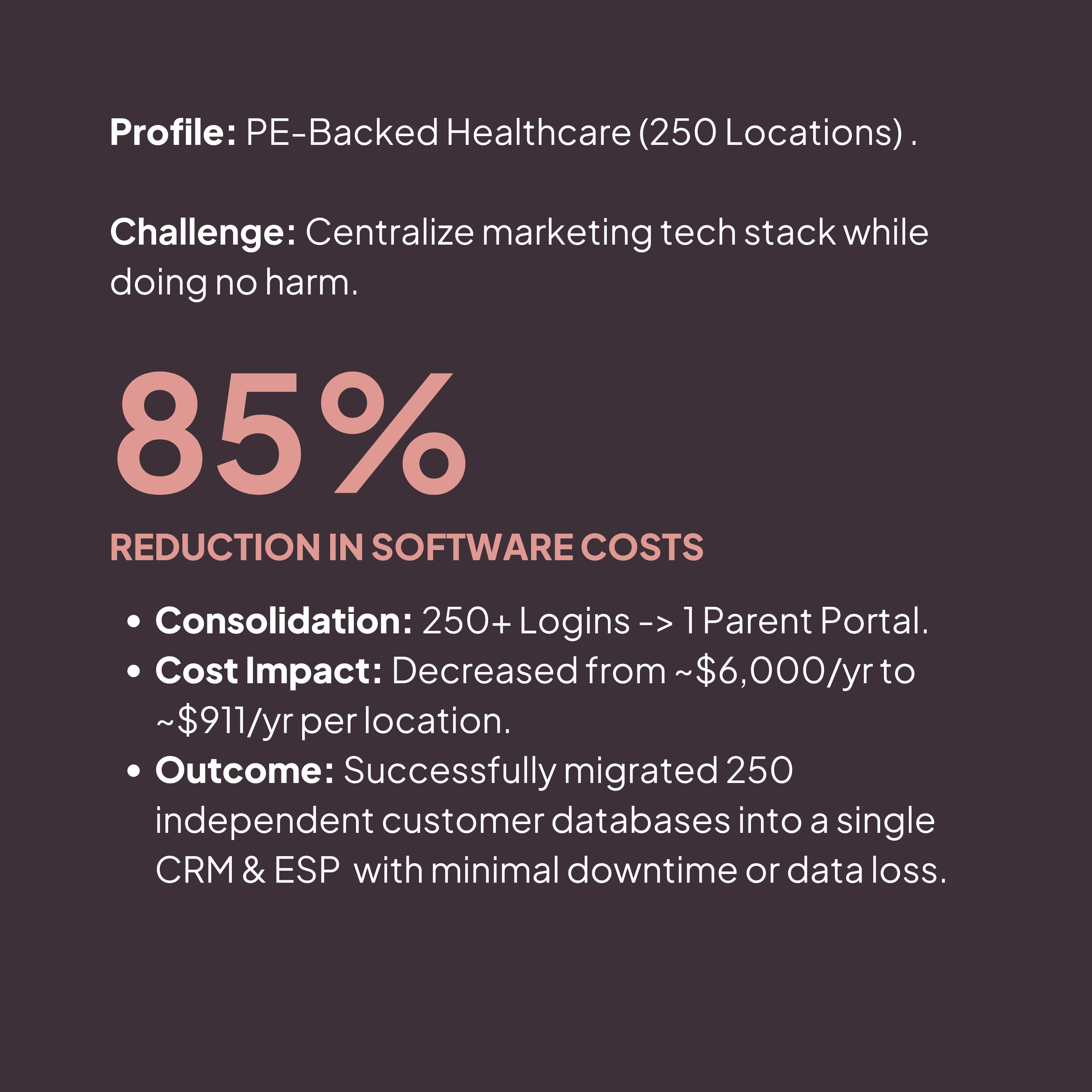
You stop buying software like a startup. By consolidating 50 separate contracts, like HubSpot or Salesforce, into one enterprise agreement, we drastically lower your per-unit cost while increasing feature access.
Economies of Skill (Talent Density)
You stop hiring generalists. Instead of needing 10 "jack-of-all-trades" managers for 10 different systems, you build one centralized operations hub. This allows you to hire deep specialists—data engineers, deliverability experts, and automation architects—who serve the entire org.
Economies of Learning (Network Effects)
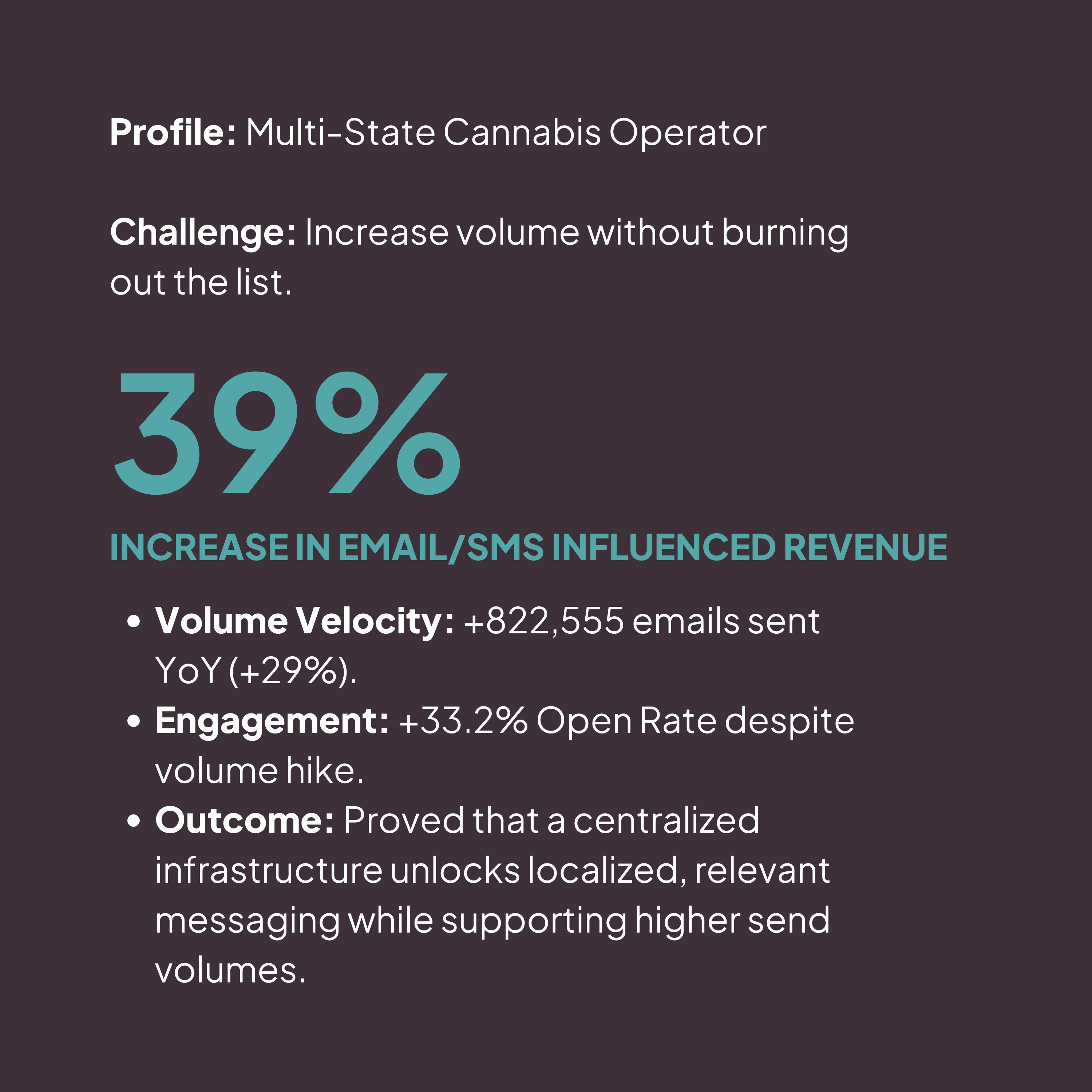
Your insights multiply. A split-test winner found by Brand A is immediately codified into the OS and deployed to Brands B, C, and D. You don't just scale revenue; you scale intelligence.
Economies of Production (Velocity)
You build an "operational assembly line." We build a high-performing email journey once. Then, we deploy that same "production-ready" asset across any brand at near-zero marginal cost. You stop reinventing the wheel and start deploying.
The OS in Action
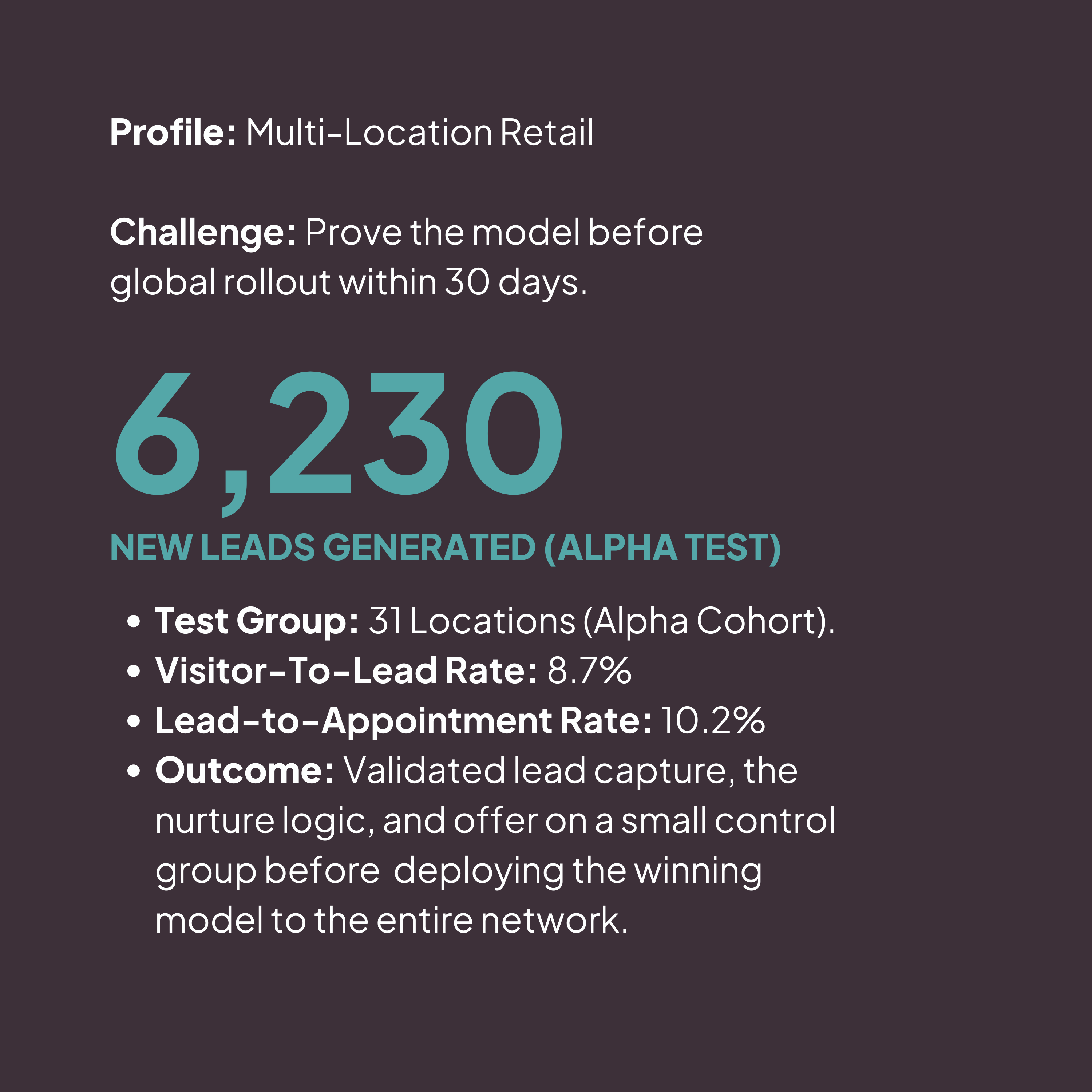
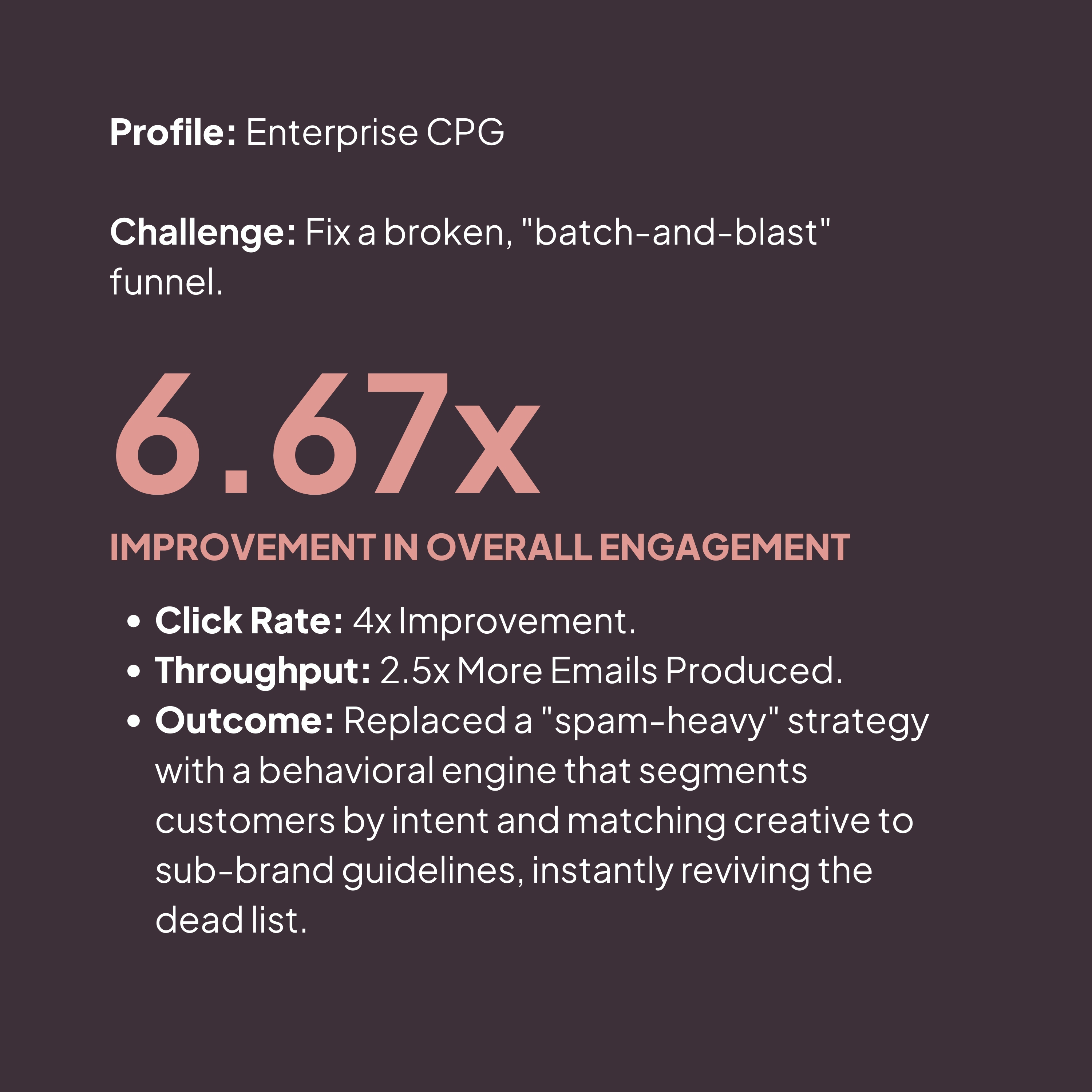
Performance data from recent multi-brand deployments.
The Engines
The Multi-Brand OS isn't an abstract concept. It is a defined scope of work delivered through three distinct operational engines.
Infrastructure Engine
(The Global Back-End) We assume total responsibility for the "boring" 80%—the data foundation that powers the entire portfolio. We build a single source of truth that ensures accurate reporting and zero redundancy.
- Multi-Brand CRM Management: Centralized administration of your customer platform instances.
- Unified Data Schema: A standardized data structure that enforces clean data entry across every brand, preventing "rogue fields" and reporting errors.
- Data Cleanliness Automation: Automated scripts that continuously monitor, merge, and clean contact records to maintain hygiene.
- Enrichment & Segmentation Pipelines: Programmatic logic that standardizes how leads are categorized and routed, regardless of which brand they enter through.
- Automated Routing & Orchestration: The logic that ensures the right lead gets to the right sales rep or brand manager instantly.
Acquisition Engine
(The Growth Standard) We stop your brands from reinventing the wheel. We replace manual, one-off landing page builds with high-speed conversion infrastructure.
- Paid Media Collaboration: We align directly with your paid media teams to ensure the handoff from ad-to-CRM is seamless.
- High-Speed Conversion Systems: Deployment of proven, fast-loading page templates designed for maximum conversion velocity.
- Dynamic Lead Capture: Standardized forms, quizzes, and pop-ups that inject local brand styling while feeding data into the global core.
- First-Click Nurture Automations: Instant, automated follow-up sequences that trigger immediately upon conversion to maximize speed-to-lead.
- Offer & Pricing Test Frameworks: A structured environment for A/B testing offers (e.g., "$ Off" vs. "% Off") across the network.
Retention Engine
(The Lifecycle Activation) We don't just store data; we activate it. We design context-aware journeys that respect consumer rhythms and inject the right message at the exact micro-moment.
- Context-Aware Journey Design: Lifecycle mapping that adapts based on customer behavior (e.g., "Active," "At Risk," "Churned").
- Real-Time Behavioral Triggers: Automations that fire based on specific user actions, such as page visits or abandoned carts.
- Dynamic Content Orchestration: The logic that swaps images, copy, and offers inside an email based on the recipient's brand affinity.
- LTV & Relationship Analytics: Deep reporting on long-term value and customer health, rolled up to the portfolio level.
70% DTC RevOps. 30% Lifecycle Marketing. 100% Multi-Brand.
We are a Center of Excellence, not a marketing agency. We don't sell hours. We sell installed capacity. We operate as a fractional team of experts that plug directly into your org chart to execute exactly that mix.
The Rules of Engagement:
-
1. Total Transparency (No Black Boxes): We work in your instances. You see every workflow, every line of logic, and every data point. Nothing is hidden behind an agency curtain.
-
2. Asset Ownership (No Vendor Lock-In): You own the code. You own the templates. You own the data. If we part ways, you keep the engine we built.
-
3. Productized Speed (No Scope Creep): We don't reinvent the wheel. We deploy pre-engineered operational blocks—tested on millions of records—to get your infrastructure live in days, not months.
Let's validate the fit.
We don't pitch. We diagnose. You have seen the specs and the outcomes. The next step is to map our infrastructure against your specific complexity.
Let's determine if the Multi-Brand OS is the right model for your organization.